
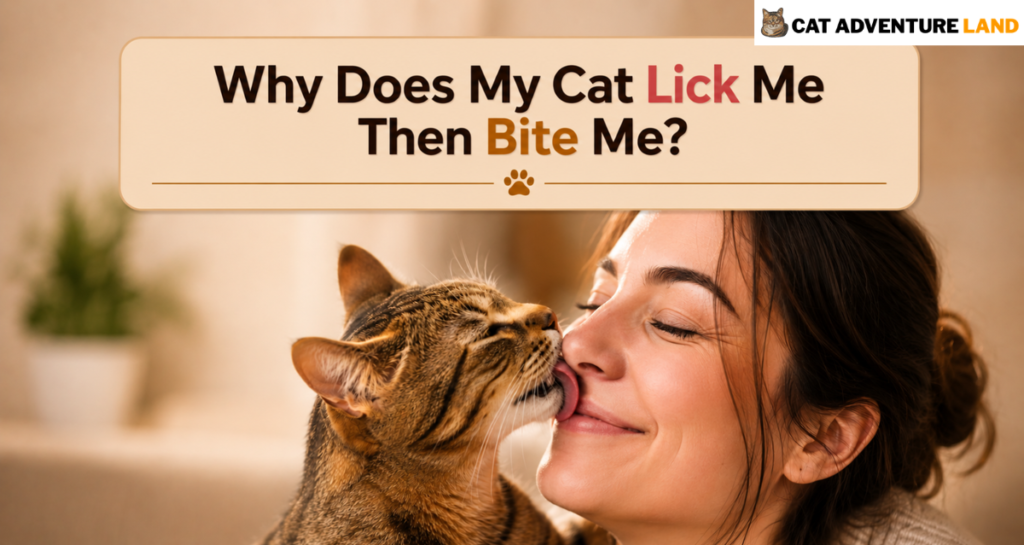
Your cat is on your lap, purring, giving your hand those slow, sandpapery licks. You think, finally, a peaceful moment. Then lick, lick, chomp. Teeth on your knuckle, just enough to make you flinch. If you have ever wondered why your cat licks you and then bites you, welcome to one of the great confusing rituals of cat ownership.
After years of living with cats, here is what this ritual teaches you. The lick-then-bite is almost never random, and it is almost never mean. It is communication with a very small vocabulary. Licking says one set of things. A bite says another. Put them together and your cat is telling you something specific about that exact moment.
Below are the nine usual reasons, how to read the seconds before teeth happen, and what to change. Once you see the pattern, you will predict the chomp before it lands.
First, the short answer: yes, this is normal
For most cats, licking followed by a gentle bite is completely normal social behaviour. Cats groom the creatures they trust, and grooming in the cat world has always included teeth. Mothers nibble kittens. Bonded cats nibble each other. You are getting the family treatment.
What matters is the kind of bite. Soft mouthing that does not hurt is a world away from a bite that breaks skin, especially one paired with hissing, growling, or flattened ears. Learning that difference is the whole game.
The 9 reasons your cat licks you, then bites
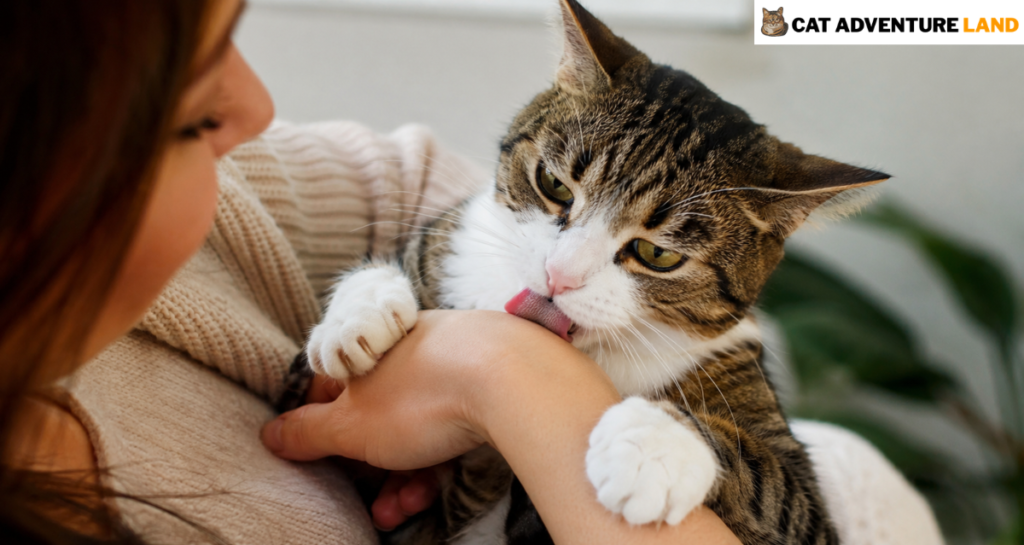
Same sequence, nine possible meanings. Context tells you which one you are looking at.
1. The classic love bite
This is the most common reason by far. Your cat licks you the way they would groom a beloved housemate, then adds a soft nibble because that is simply how cats groom. Watch a pair of bonded cats and you will see the exact same rhythm: wash, wash, nibble.
You will know it is a love bite because everything else stays soft. Purring continues, the body stays loose, claws stay in, and the bite itself feels like pressure rather than pain. My old girl used to do this on my forearm every evening, three licks and one gentle squeeze, like punctuation at the end of a sentence. If gentle mouthing is your cat’s main habit, I break it down further in why your cat bites you gently.
- Soft and brief, never breaking skin
- Painless pressure, not a clamp
- Paired with purring and a loose body
- Happens during calm cuddle time
- Feels deliberate, not snappy
2. You are being groomed like family
Mutual grooming (allogrooming) is reserved for a cat’s inner circle. When your cat licks your hair, hands, or arms and finishes with tiny nibbles, they are doing to you exactly what they would do to a trusted cat friend: washing, then working through the fur with their teeth. You just happen to have less fur than expected.
Take it as the compliment it is. Cats do not groom people they dislike. A cat that regularly chooses your arm as a grooming project is a cat that feels safe. If the nibbles tickle, slide a toy under their chin instead of yanking away. Sudden pulling turns sweet moments into startled bites.
3. “Okay, I have had enough”
Here is the scenario every cat owner knows. The petting starts perfectly. Two minutes in, something shifts. The purring gets tighter, the tail starts talking, and then the hand that was welcome gets bitten. This is petting-induced overstimulation: your cat’s sensitive skin simply hit its limit.
Think of petting like tickling a child: lovely at first, unbearable past a point. The bite is your cat’s polite way of pushing your hand off. Warning signs always come first (tail flicking, flat ears, wide pupils, rippling back skin, a tense body, the head tracking your hand), so end the session yourself with a scratch behind the ears and a calm withdrawal.
4. Play ambush in disguise
Sometimes the lick is just the opening move of a game. Lick, lick, grab with both paws, bunny-kick, sprint away. Indoor cats carry the full hunting toolkit with nowhere to use it, so your hand becomes the mouse. Kittens, young adults, and high-energy breeds are the worst offenders, and underplayed cats of any age join in.
Playful biting gives itself away fast. It comes with pouncing, chasing, sideways hops, swatting, and the classic dash away followed by an immediate return for round two. Skip punishment and schedule real play instead: a wand toy or feather teaser to chase and catch twice a day, so your hands can retire from active duty.
5. It worked before, so it works now
If a small bite once made you look up from your laptop, laugh, or produce dinner, your cat filed that lesson permanently. Lick to say hello, bite to say hey, you, now.
The sneaky part is that any reaction counts as success, including scolding. A dramatic OW is still attention, and for a bored cat at 9 p.m., drama beats being ignored. Flip it: be dull about bites and generous with calm behaviour. Quiet company earns stroking and chat. Teeth earn a freeze, then withdrawal. Most cats learn the new rules within weeks.
6. Stress is leaking out sideways
A new home, a new pet, visitors, building noise, a rearranged room, a changed work schedule. Some cats show it through their mouths: clingier than usual, grooming you or themselves excessively, asking for constant reassurance, then biting out of nowhere when their nerves are frayed.
If the licking and biting surged right after something in your home changed, treat the change as the prime suspect. Hold their core territory steady, keep feeding and playtimes predictable, and give them a hideaway nobody disturbs. Most cats settle as the new normal starts feeling normal. If they do not, or the behaviour keeps escalating, loop your vet in.
7. Something hurts
A cat in pain rarely announces it. What they do is lower their tolerance to zero. The same stroking they loved last month now earns a bite, because underneath your hand something aches. Dental pain, arthritis, itchy skin, fleas, a sore ear, or an old injury can turn a tolerant cat into a sudden biter.
I am not a vet, so take this as a flagging system, not a diagnosis. If the biting appeared suddenly, keeps increasing, clusters around one body area, or shows up in an older cat alongside appetite or mood changes, book a checkup before trying any training. Pain is the one cause you never want to train around.
8. Your kitten is still learning the rules
Kittens explore the world mouth first, the way human babies grab everything with their hands. Lick it, bite it, learn it. Add teething soreness, a brain wired for play-hunting, and (in some kittens) too little time with mum and littermates to learn bite control, and you get a tiny creature who licks then bites fifty times a day.
The good news: this is the most temporary version of the habit. With chew toys, calm redirection, and consistent reactions, most kittens grow noticeably gentler month by month. More on kittens below.
9. You accidentally taught it (no guilt)
When your cat bit you that first time, did you laugh, chat, offer a treat, or start a wrestling game? Congratulations, you paid for the behaviour. Cats repeat whatever earns good outcomes, and attention plus treats plus play is the jackpot.
This is the easiest cause to fix because the lever is entirely in your hands. Same response every time: teeth mean the fun pauses. Calm mouths and gentle paws mean affection, play, and the occasional treat. Consistency across the whole household matters more than perfection from one person.
Love bite or real warning? Read it in seconds
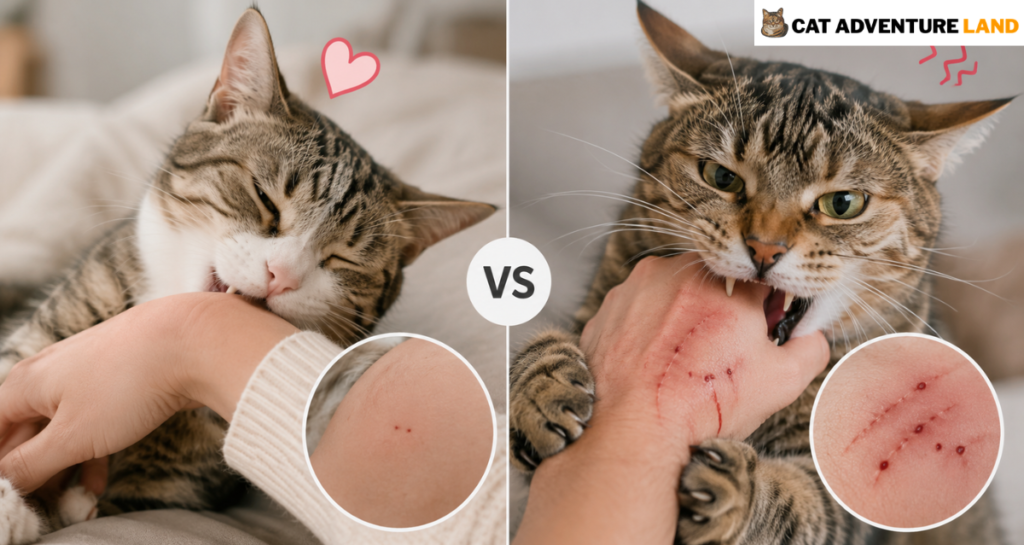
New owners ask me about this constantly, so here is the fastest field guide I know. Run through it mid-cuddle and you will know exactly what is happening. Veterinary behaviourists describe the same spectrum in this behaviour guide on Cats.com.
| Signal | Love bite | Warning bite |
| Pressure | Soft mouthing, no pain | Hard clamp, may break skin |
| Body | Loose, purring, maybe kneading | Tense, twitchy, shifting away |
| Ears and eyes | Relaxed, slow blinks | Flat ears, wide pupils, hard stare |
| Sound | Purring or silence | Hissing, growling, sharp cry |
| Afterwards | Settles back down | Leaves, hides, or escalates |
One gentle nibble during a purr is a compliment. Repeated hard bites are a message with an exclamation mark. Answer it with space, quiet, or a vet visit, not punishment.
The 8 warnings that come before teeth
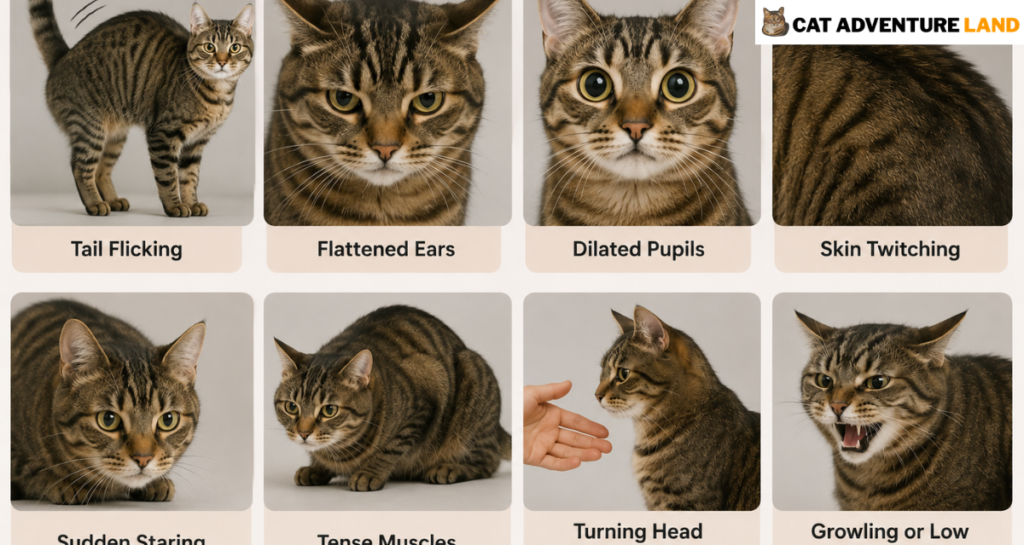
Cats almost never bite without announcing it. The announcements are just small. Learn these eight and you will see bites coming a minute away.
- Tail flicking. Calm tails sway slowly. Fast flicks and thumps mean irritation is climbing.
- Ears flattening. Ears sliding back or sideways signal discomfort. The flatter they go, the closer the bite.
- Pupils dilating. Wide, round pupils mean arousal of some kind: excitement, fear, stress, or overstimulation.
- Skin twitching. Ripples along the back mean the limit is near.
- Sudden hard staring. A cat locked onto your hand is deciding about it. Withdraw.
- Muscles tensing. A relaxed cat feels like warm dough. A stiff, coiled cat is done being touched.
- Head turning toward your hand. The clearest signal of all. Your cat is lining up the bite. Freeze, then slowly withdraw.
- Growling or low grumbling. An audible warning. Respect it and the bite never happens.
When you spot any of these, stop touching, move slowly, and let your cat reset. Walking away teaches them that small signals work, so big ones stay unnecessary.
Why kittens do this ten times more
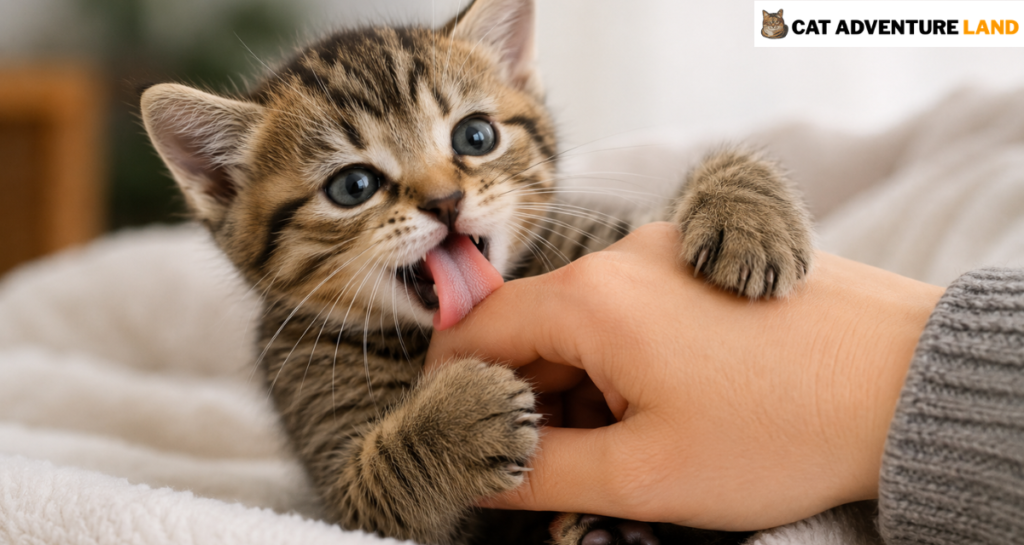
If you live with a kitten, multiply everything above by ten. That is normal. Kittens are running three programmes at once, and all three involve teeth.
Teething hurts, chewing helps
Like human babies, kittens get sore mouths as adult teeth push through, and your fingers are conveniently everywhere. Keep a chew toy within reach and swap it in every time. Teething chewing fades as adult teeth settle.
Bite control is learned, not installed
Kittens learn bite control from mum and littermates, who yelp and walk off when teeth cross the line. A kitten separated very young can miss those lessons. Be their teacher: a calm ouch, play stops for thirty seconds, then resume. They learn fast when the rule never wavers.
Everything is hunting practice
Kittens rehearse the full hunt dozens of times daily, and your moving hand reads as premium prey. Scheduled play with toys they can catch and kill drains this battery. Training good habits young pays off for years, and a structured plan like my 3-month cat training guide makes it almost automatic.
Most kittens grow gentler with age, toys, training, and patience.
5 mistakes that manufacture biters
We usually build this habit by accident. Five classics:
- Wrestling with bare hands. Letting them bite your fingers teaches that skin is a toy. Hands are for stroking, toys are for biting. No exceptions.
- Missing the early warnings. Most bites follow a full minute of ignored signals. Pet through them and the bite is information, not betrayal.
- Forcing cuddle marathons. Some cats adore hour-long laps, others tap out at five minutes. Respecting the tap-out earns longer sessions over time.
- Punishing after the bite. Yelling, spraying, or shoving teaches fear, not manners. Fearful cats bite more, and trust takes far longer to rebuild.
- Skimping on play. An unplayed cat is a loaded spring. Ten minutes with a wand toy, twice daily, prevents more bites than any correction.
The calm-mouth playbook: what actually works
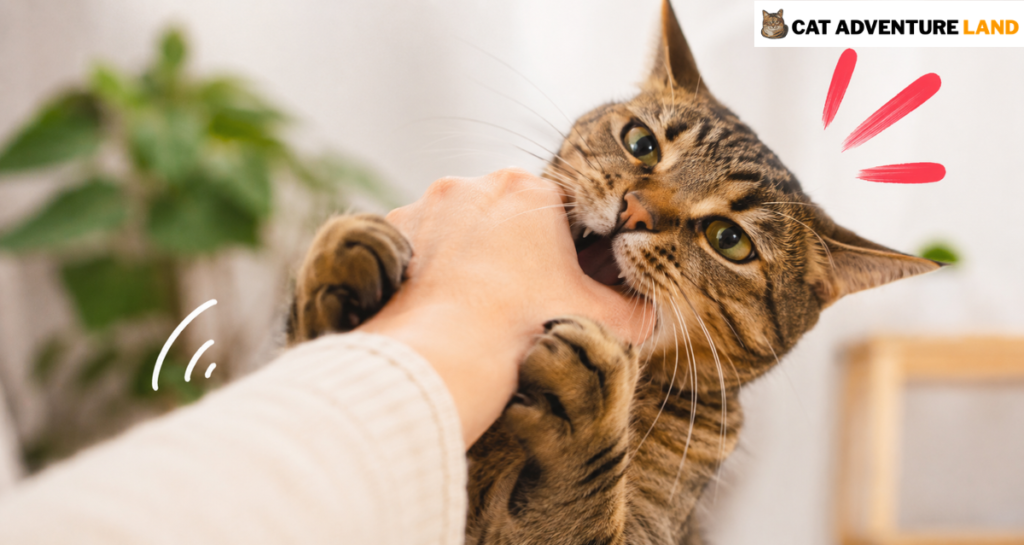
No single trick fits every cat. This five-part routine covers nearly all of them.
Learn your cat’s personal limits
Every cat has a number: three strokes, ten, one minute of belly rubs, none. Notice when the tail starts talking and make stopping there your habit. Ending one stroke before the limit stretches the limit over time.
Play on a schedule, not on demand
Morning and evening, ten to fifteen minutes with interactive toys, ending with a catch so the hunt feels complete. A tired hunter is a gentle companion.
Pay for the behaviour you want
Reward gentle moments with praise, a chin scratch, or a treat. Positive reinforcement builds habits punishment never can. Small, tasty rewards work best for training moments, which is why I keep a guide to the best cat treats for training on hand for exactly these sessions.
Retire your hands from rough play
Make this rule absolute. Hands and feet never become wrestling opponents, not even with tiny kittens where it seems harmless. What is cute at eight weeks is scary at eight pounds. Redirect to a kicker toy every time.
Make home base feel safe
Scratching posts, a high perch, a hiding spot, and predictable routines. A secure cat has a longer fuse everywhere, including your lap.
When biting means a vet visit
Most of this is harmless conversation. Call your vet if the tone changes:
- The behaviour starts out of nowhere
- Bites turn unusually hard or frequent
- Your cat flinches, cries, or guards one body area
- Appetite, thirst, or weight shifts
- Your cat withdraws or turns irritable
- Grooming turns obsessive, with bald spots or sores
- Things keep getting worse, not better
A medical cause can hide behind any of these, and a checkup is cheap peace of mind.
Final thoughts: listen to the lick, respect the bite
Next time your cat washes your hand then adds teeth, run the checklist. Soft body and purring means affection. Twitchy tail and pinned ears means overstimulation. Laptop open means attention, almost certainly. Context decodes everything.
Owners who read the seconds before a bite end up with cats who bite less and trust more, because every respected signal strengthens the relationship. A lovely trade for paying attention.
FAQs about cats licking then biting
What does it mean if a cat licks you and then bites you?
It means your cat is talking. The message could be affection, grooming, overstimulation, play, an attention request, or discomfort. Check the body language around the bite and the meaning usually becomes obvious.
Why does my cat lick me then bite me while purring?
Purring plus a gentle bite is the classic love bite. Your cat is relaxed and including you in social grooming. As long as the bite stays soft and the body stays loose, enjoy it. That is trust in action.
How can I tell if my cat is bonded with me?
Bonded cats follow you between rooms, slow-blink at you, purr in your company, sleep touching you, rub against you, and groom you (nibbles included). If your cat does three or more of these daily, consider yourself claimed.
Should I stop my cat from giving love bites?
Gentle ones are healthy social behaviour and need no stopping. If they get harder or more frequent, calmly pause the interaction when teeth press too firmly and reward gentle contact. The pressure usually softens within a week or two.
What is the difference between a love bite and an aggressive bite?
Love bites are soft and brief, paired with a relaxed, often purring body. Aggressive bites press hard or break skin and come with warnings like hissing, growling, flat ears, or a tense body. Pressure plus body language tells you which is which.
Why does my kitten lick me and then bite me?
Kittens teethe, explore mouth-first, and practise hunting through play, often all in the same minute. Redirect to toys, keep reactions calm and consistent, and watch the habit fade as they mature.
When should I worry about my cat’s biting behaviour?
Worry when the pattern changes: sudden onset, harder bites, injuries, or biting with pain, appetite changes, withdrawal, or obsessive grooming. Any of those earns a vet visit before you try training fixes.
Can stress make a cat lick and bite more often?
Yes. New homes, pets, visitors, noise, or routine upheavals can raise licking and biting. Steady the environment, keep routines predictable, and give it a week or two. Persistent escalation deserves a vet’s input.

Cat Adventure Land is created for cat lovers who want simple guidance that actually helps. Here you get friendly advice on daily cat care feeding grooming training and overall wellbeing. Every article is written with a focus on real life situations so you can understand your cat better and give them a healthier happier life. Our goal is to make cat care easy for everyone whether you are a new owner or caring for a senior cat.