It’s 2:47 a.m. The house is dark, you’re half-asleep, and then it starts. That long, echoing meow from the hallway. If you’ve ever sat up in bed wondering why your cat meows at night, you’re in good company. It’s one of the most common questions cat owners ask, and one I’ve lived through with more than one cat.
Here’s the reassuring part: in most homes, cat meowing at night is communication, not misbehaviour. Your cat isn’t plotting against your sleep. They’re answering to instinct, habit, or a need you haven’t spotted yet. Once you learn to read the pattern, the nights usually get quieter.
Your cat isn’t nocturnal. They’re on a different clock

Cats aren’t truly nocturnal. They’re crepuscular, wired to be most active at dawn and dusk. Their internal clock, the feline circadian rhythm, runs on a totally different schedule from ours. In the wild, that twilight schedule is perfect for hunting.
In our homes, the same wiring is why a cat naps all afternoon and then holds a concert at midnight. Anyone who’s lived with cats knows the 5 a.m. zoomies. When the house goes dark, their active window opens. If the day had no structure, that energy comes out as pacing, hallway sprints, or crying simply because they’re wide awake and you’re the most interesting thing around.
The mismatch at a glance:
| Behaviour type | Wild cats | Indoor cats |
| Active hours | Dawn & dusk | Naps by day, bursts at night |
| Sleep pattern | Light sleep in cycles | Long daytime naps |
| Vocalising | Rare | More frequent, learned from humans |
Why everything gets louder after lights-out

Night changes the world from a cat’s point of view. The house goes silent, there’s nothing to watch, and the humans become unresponsive lumps under blankets. For an animal that’s just waking up, that’s genuinely confusing.
Three things collide: instinct sharpens in silence, learned behaviour kicks in (most of us have got up and fed the crying cat at some point, and cats never forget what works), and unmet needs feel bigger in a quiet house. A slightly empty stomach is easy to ignore at noon and impossible to ignore at 2 a.m. Researchers studying feline vocalisation keep coming back to this same mix. If you like the science, this behaviour guide on Cats.com goes deeper.
So hallway crying is rarely one single cause. Usually it’s a small stack of them. That’s good news: small fixes in a few places add up fast.
The 5 real reasons your cat cries at night
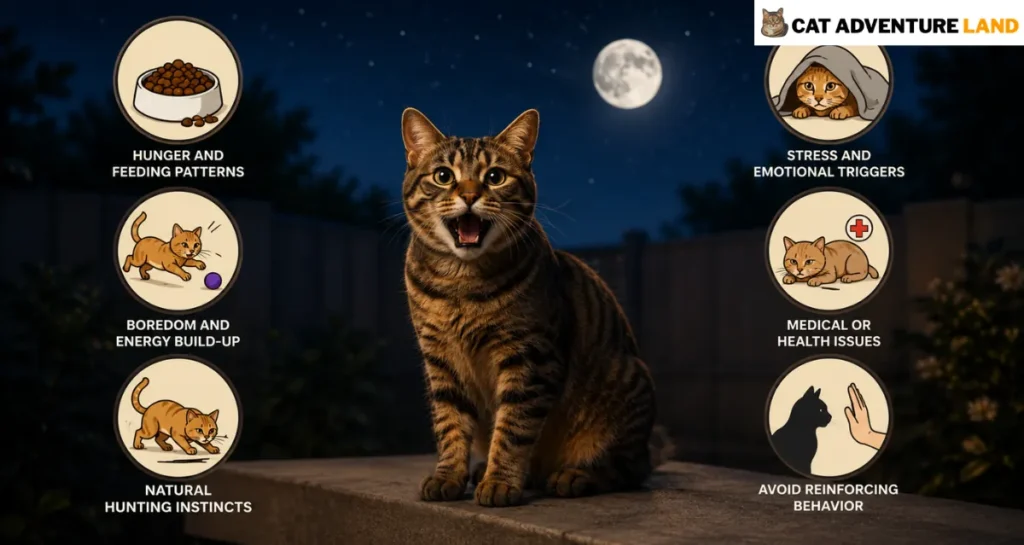
Nearly every case traces back to one of five roots, sometimes two at once. Work through them like a detective.
1. “Dinner was hours ago”: the empty-bowl wake-up call
Hunger is the number one suspect, especially for early-morning crying. Cats are grazers, not one-big-meal animals. If dinner lands at 6 p.m. and bedtime is 11, that’s a long stretch on an empty stomach, and your cat knows exactly who controls the food.
And here’s the trap: the cat cries, you fill the bowl to buy silence, and the cat learns that meowing gets breakfast served early. Within a week, you’ve got a punctual 4:30 a.m. alarm clock with whiskers. The fix is simple: split the evening food in two: dinner, plus a small meal right before bed. One reader told me this one change ended months of 5 a.m. wake-ups in under a week.
2. A bored cat is a loud cat
Picture your indoor cat’s day: the house sits still for nine hours, and with nothing to chase or solve, the cat sleeps through it. Then dinner, TV, bed. Meanwhile your cat, fully rested, is ready for their main event. That unused energy comes out as midnight sprints and hallway commentary. (Sleep shifts with the seasons too. Here’s whether cats really sleep more in summer.)
Try this: rotate toys so there’s always something “new,” leave a puzzle feeder out, and clear a window perch for bird-watching. Boredom is one of the easiest causes to fix.
3. The midnight hunting shift
Even the laziest couch-lion carries strong hunting instincts. Low light flips a switch: shadows become prey, your toes become prey, and that excited yowling is thrill and frustration in one. A 3 a.m. yowl is often just a hunting sequence with no finale.
My rule of thumb: bouncing, sideways hops, and glowing eyes mean play-hunting, not aggression. Give it an outlet before bed: a feather wand, a crinkly ball, anything to chase and “kill”, so the hunting shift ends before yours does.
4. Something changed, and they’re telling you about it
Cats are creatures of habit in fur coats. A new pet, a moved sofa, guests, even new work hours can stress them out. Since they can’t file a complaint, they vocalise: sudden night meowing, pacing, or swinging between clingy and hidden. Classic case: you rearrange the living room on Sunday, and Sunday night brings an hour of hallway crying. Nothing is wrong. Their mental map just got redrawn. Clinginess often comes with it; if yours shadows you all day, here’s why cats follow you everywhere.
The fix is patience plus stability: keep their core territory untouched, add a play session for reassurance, and give them a hideaway that’s theirs alone. Most cats settle within a week or two.
5. When it’s health, not habit: red flags to take seriously
The one category to never brush off. If a normally quiet cat, especially a senior, suddenly starts crying at night, don’t assume it’s behavioural. Pain and confusion surface after dark, when the house is still and nothing distracts from discomfort.
Conditions vets commonly link to new or excessive night-time vocalisation:
| Condition | What you might notice at night |
| Hyperthyroidism | Restlessness plus extra vocalisation |
| Kidney disease | Waking often, seeming restless or uncomfortable |
| High blood pressure | Pacing, appearing confused |
| Cognitive decline (in seniors) | Disorientation, crying in empty rooms |
I’m not a vet and this isn’t a diagnosis. It’s a nudge. New night crying, especially with appetite, weight, thirst, or behaviour changes, means a vet visit before any training fixes.
Why always the bedroom door?
Shut the bedroom door and the crying starts within minutes. Half of all cat owners will laugh in recognition. From your cat’s side the logic is flawless: all day they can reach you, and now there’s a barrier with audible breathing behind it.
- They want to be near you. Closed doors offend a cat’s territorial instincts
- They want reassurance, especially after a change at home
- They’ve learned persistence opens doors. Cats train humans well
What worked in my house: one rule, kept for two weeks: door open or door shut, no switching. Add a comfy bed outside the door and stay boring and silent when they cry. And if yours stares at you once inside, that’s covered in why cats stare at you while you sleep.
Behaviour problem or vet visit? How to tell
| Type | Signs | What to do |
| Behavioural | Predictable, routine meowing at set times | Routine and training changes |
| Environmental | Boredom or restlessness after a change | Enrichment plus a calmer setup |
| Medical | Sudden change, confusion, or signs of pain | Vet check first |
Trust the timeline: gradual, patterned meowing is usually behavioural; sudden or confused crying, especially in an older cat, deserves a vet’s opinion. You know your cat’s normal night-time behaviour better than anyone.
When night-time meowing is actually a problem
An occasional chatty night is just cat ownership. Treat it as a red flag if:
- Crying starts suddenly in a previously quiet cat
- Your cat seems confused or stares into corners
- Appetite, thirst, or weight changes
- Meowing turns constant, louder, or distressed
- A senior cat’s behaviour shifts quickly
Any one of these is worth a vet call. Cats hide illness well. Night crying is sometimes the first crack in the disguise.
What actually quiets the nights
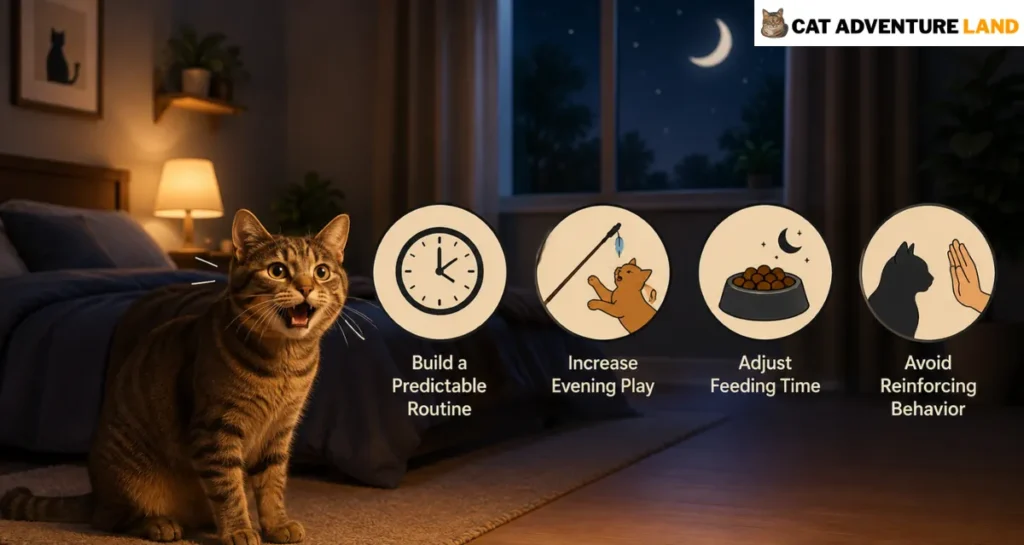
No punishment, no squirt bottles. Reshape the evening so your cat reaches bedtime tired, fed, and settled. And stop rewarding the performance.
Keep evenings boringly predictable
Feed, play, and wind down at the same times daily. A steady rhythm regulates their sleep cycle better than any single trick, and anxious cats relax once they can predict the evening. Even keeping weekends within an hour of weekdays helps.
Play hard, then serve dinner
Behaviourists swear by this sequence: hunt, eat, groom, sleep. An hour before bed, ten to fifteen minutes of real play with a wand toy to chase and catch, then the small late meal. A successful “hunt” plus a full belly is nature’s off-switch. Expect flopping, face-washing, then silence.
Stop paying the toll, as a household
If crying earns food, conversation, or a grumpy “shhh!”, it gets stronger, because any response is payment. Be profoundly boring at night, then reward the quiet: morning fuss and breakfast arrive after silent nights. Everyone must comply, because one 4 a.m. snack resets the whole cycle of overnight meowing. The first nights are worst; most cats give up within a week.
Mistakes that train your cat to meow more
Almost every chronic case includes one of these:
- Feeding right after crying, which teaches that noise works
- Chatting back at 3 a.m., because a scolding is still quality time
- All-day nap marathons, which guarantees a wild night
- Mixed household signals, because if it works on one person, they’ll try everyone
None of this makes you a bad owner, just a tired human. The good news: untraining works as well as training did.
A calm night starts with a balanced cat
Solving night meowing comes down to one question: is it the body (hunger, health), the environment (boredom, change), or habit (a routine you built together)? Name it, and the fix is usually simple: a shifted mealtime, better play, or a vet check for peace of mind.
Most night criers aren’t troubled. They’re healthy, clever animals on hunter software in a human-schedule house. Meet them halfway and you’ll both sleep better.
FAQs about cats meowing at night
How do I get my cat to stop meowing at night?
Fixed mealtimes with a bedtime snack, real evening play, and zero night-time rewards: no feeding, no chatting, no getting up. Most cats adjust in one to two weeks. Sudden crying or a senior cat? Vet first.
Should you ignore a cat’s meow at night?
Once health issues and basics (food, water, clean litter) are ruled out, yes. Calmly ignoring attention-seeking cries works fastest. But check anything sudden or out of character first. Attention meows fade when they stop paying; pain needs a vet, not patience.
What does it mean when cats meow at night?
Your cat wants something you’re the source of: food, company, play, or reassurance. Occasional chatter is normal; frequent or brand-new crying means checking routine, stress, and health, in that order.
How do I say “I love you” in cat language?
Speak cat: a slow blink, a returned head-bump, or calm company. Cats read quiet presence as love. Owners with a calm pre-bed ritual often find their cat settles faster. Affection and quiet nights are related.

Cat Adventure Land is created for cat lovers who want simple guidance that actually helps. Here you get friendly advice on daily cat care feeding grooming training and overall wellbeing. Every article is written with a focus on real life situations so you can understand your cat better and give them a healthier happier life. Our goal is to make cat care easy for everyone whether you are a new owner or caring for a senior cat.